An informed response to The Australian’s reporting on the future of the Kokoda Track.
By Glenn Azar | Founder and Director, Adventure Professionals | 100 Kokoda Track Crossings
Recently, The Weekend Australian published an article by journalist John Ferguson titled The future of the Kokoda Track hangs in the balance. Can it survive for a new generation?
It’s an important question. One that deserves serious discussion, informed debate and thoughtful consideration.
But having spent more than 20 years working on the Kokoda Track, and having completed my 100th crossing earlier this year, I believe the article presents an incomplete and, in several respects, misleading picture of an industry, a place and a people I know intimately.
Let me be clear from the outset.
I welcome conversations about the future of Kokoda. I welcome scrutiny of the authorities responsible for managing it. I absolutely support preserving its extraordinary military heritage.
But those conversations must be informed, balanced and grounded in evidence.
There’s a significant difference between identifying problems and accurately explaining what caused them. And there’s an equally significant difference between expressing an opinion and establishing a fact.
Unfortunately, I believe the article blurs those distinctions.
The Danger of a Single Narrative
Firstly, I want to acknowledge that John Ferguson actually walked the Kokoda Track.
He experienced the terrain, the humidity, the relentless climbs and descents, and the extraordinary history that makes Kokoda such a special place.
I respect that.
I also appreciated the reflections of the young Australians who accompanied him. Their experiences demonstrate precisely why Kokoda remains such a powerful opportunity for personal development, education and connection with our military history.
But the article relies heavily on the views of Charlie Lynn, a long-time Kokoda trekking operator who has publicly criticised the management of the Track for many years.
Charlie has made contributions to Kokoda tourism, particularly in promoting its military heritage. He is certainly entitled to his opinions.
However, longstanding advocacy does not automatically establish the accuracy of every claim.
Nor should one operator’s perspective be mistaken for a consensus across the industry.
When someone has campaigned on an issue for decades, journalists have a responsibility to examine their claims, seek alternative perspectives and establish whether the evidence supports the conclusions being presented.
That is particularly important when those claims concern international relationships, government funding, tourism and the livelihoods of Papua New Guinean families.
Declining Trekking Numbers: Correlation Is Not Causation
There is no dispute that Kokoda trekking numbers have declined from their peak.
In 2008, the Kokoda Track Authority recorded 5,621 trekkers.
In social media commentary accompanying the article, Charlie Lynn claimed that management arrangements introduced in 2008 had caused trekking numbers to decline by 52 per cent, resulting in 7,000 fewer jobs for Papua New Guinean guides and carriers.
These are significant claims.
But where is the evidence demonstrating that the management arrangements were the primary cause of the decline?
Consider what has happened since 2008.
We’ve experienced the global financial crisis, substantial changes in international tourism, rising travel costs, evolving consumer preferences, changes in insurance and travel requirements, and the unprecedented disruption of COVID-19.
For a significant period, international travel effectively stopped.
Kokoda was not immune.
There may well be management decisions that have negatively affected the trekking industry. If so, they deserve investigation.
But identifying a peak year and comparing it with current figures does not, by itself, establish why the decline occurred.
Correlation is not causation.
The claim of 7,000 fewer jobs also requires clarification.
Are we talking about permanent employment? Seasonal positions? Individual trekking engagements? Or working days?
These are fundamentally different measures.
As someone who employs a substantial Papua New Guinean team, I understand the importance of every trekking opportunity.
Reduced visitor numbers absolutely affect livelihoods.
But if we’re going to make claims about thousands of lost jobs, we should be able to explain exactly how those figures were calculated.
Kokoda deserves an evidence-based discussion, not simply a collection of dramatic statistics.
What Is the Kokoda Initiative Actually Doing?
Another claim that deserves closer examination is that Australian aid funding has been directed towards climate change and gender-based violence at the expense of Kokoda’s military heritage.
The published framework of the Kokoda Initiative Partnership includes three pillars:
Track. People. Environment.
The Track pillar includes military heritage protection, track management and maintaining the trekking experience.
The People pillar focuses on health, education, livelihoods and community development.
The Environment pillar recognises the importance of protecting the extraordinary natural landscape surrounding Kokoda.
These responsibilities are interconnected.
And importantly, the initiative’s work extends beyond what an Australian visitor might observe during an eight- or nine-day trek.
At Naduri, for example, there has been work to improve the local health facility, including renovations and medical support.
These are precisely the kinds of projects that deserve greater attention when discussing the effectiveness of development initiatives in the region.
A functioning health facility matters to a mother with a sick child.
Access to medical professionals matters to elderly villagers.
Improved education and clean water matter to the next generation of Papua New Guineans.
We cannot reasonably claim to honour the Fuzzy Wuzzy Angels while treating the wellbeing of their descendants as secondary to our preferred version of battlefield tourism.
Military heritage and community development should not be competing priorities. They should be complementary responsibilities.
Tim Bryson: A Perspective Worth Hearing
Following the publication of Ferguson’s article, Tim Bryson, Group Head of External Affairs for Digicel, offered a response that deserves serious consideration.
As a senior business leader operating in Papua New Guinea, Bryson brings a perspective informed by the complexities of business, infrastructure and development in the country.
He begins by acknowledging the remarkable beauty of Kokoda, the generosity of its landowners and the extraordinary experience of walking the Track.
But he also highlights something that can be overlooked by those viewing Papua New Guinea through an Australian lens.
Development in PNG is complex.
Infrastructure is expensive.
Logistics are difficult.
Government administration, land ownership, geography and competing priorities all influence the speed and sustainability of progress.
Bryson writes:
“If development in PNG was as easy as some claim it is, then so many nation-wide issues would already be resolved.”
It’s an important observation.
Pointing out problems is relatively easy.
Working collaboratively to solve them in a remote and complex environment is considerably more difficult.
Bryson acknowledges that improvements are needed along Kokoda. But he also points to the many government agencies, NGOs, businesses, trekking companies and local leaders already working to deliver those improvements.
He is particularly critical of the trekking company featured in Ferguson’s article, alleging a longstanding pattern of public criticism, resistance to cooperation and attempts to dominate relationships with local stakeholders.
These are Bryson’s assessments, rather than independently established findings. Nevertheless, they reinforce the importance of hearing a broader range of industry perspectives.
His response also provides specific examples of development activity largely absent from the article.
Bryson points out that an Australian-funded information panel is visible in the background of footage apparently filmed at Ioribaiwa.
This is particularly relevant to claims that historical interpretation along the Track is almost nonexistent.
He also describes Australian and NGO-funded health and education training, Australian-funded but PNG-operated health patrols, improvements to classrooms and clean water facilities, and support for schools throughout the wider Kokoda region.
Bryson states that maternal and child health indicators along the Track compare favourably with those in other remote parts of Papua New Guinea. That is a claim worth testing against published health data, but it also highlights an area of development that deserves investigation.
He references more than 50 schools across the broader region, including communities beyond the immediate trekking route.
And that raises an important point.
The Kokoda region is considerably larger than the narrow corridor most trekkers experience.
There are villages, families and communities beyond the immediate view of Australian visitors.
A health patrol reaching a remote village may not make for a dramatic headline.
Neither might a new classroom, clean water infrastructure or improved access to maternal healthcare.
But for the people who live there, these investments can be life-changing.
Perhaps the most important message in Bryson’s response is this:
“To achieve that it’s much better to join forces constructively with all those who care about Kokoda.”
That is a sentiment I wholeheartedly support.
We don’t need everyone to agree on every issue.
We don’t need to pretend that management is perfect.
But surely we can recognise that meaningful progress requires cooperation rather than endless confrontation.
Kokoda Is More Than an Australian War Memorial
This is perhaps the most important point I want to make.
Kokoda is not simply an Australian battlefield.
It is home.
Home to families who have lived in those mountains for generations.
Home to the descendants of the people who helped Australian soldiers during the Second World War.
Home to people whose lives continue long after Australian trekking groups have completed their journeys and returned home.
When we visit Kokoda, we are visitors in another country.
We are walking across land owned by Papua New Guinean communities.
And that reality should shape the way we discuss its future.
Australia has a profound historical connection to Kokoda.
We have an obligation to remember the courage, service and sacrifice of those who fought there.
But we must also respect Papua New Guinea’s sovereignty and the rights and aspirations of the people whose land carries that history.
I find it difficult to understand how we can speak so passionately about the Fuzzy Wuzzy Angels and their extraordinary contribution to Australia, yet give comparatively little attention to the wellbeing of their descendants.
These are not competing responsibilities.
They are connected.
And any meaningful plan for Kokoda’s future must recognise both.
The Extraordinary People Who Make Kokoda Possible
Over more than two decades, I’ve had the privilege of working alongside hundreds of Papua New Guinean guides and carriers.
These are some of the most remarkable people I’ve ever met.
Their strength, patience, humour, generosity and willingness to help others are qualities I have witnessed repeatedly.
They are not simply employees carrying backpacks through the jungle.
They are fathers, brothers, sons, community leaders and providers.
They are people with families, ambitions, responsibilities and hopes for the future.
Many are descendants of the people whose contribution to the Kokoda campaign we commemorate.
And every time an Australian completes the Track, these men play a significant role in making that achievement possible.
When we talk about Kokoda’s future, their voices deserve to be heard.
So do the voices of landowners, village leaders, women, young people and families living throughout the region.
What improvements have they witnessed?
What challenges remain?
What do they want for their communities?
What do they believe Kokoda should look like in 10 or 20 years?
Those questions should be central to the discussion.
Because no Australian trekking operator, myself included, should presume to speak on behalf of every Papua New Guinean connected to the Track.
Preserving Military Heritage Without Losing Kokoda’s Character
One area where I agree with Ferguson’s article is the importance of protecting and interpreting Kokoda’s military heritage.
I’ve stood at Isurava, Brigade Hill, Templeton’s Crossing, Eora Creek and Ioribaiwa more times than I can count.
And those places never lose their significance.
I’ve watched grown men cry at Brigade Hill.
I’ve watched young Australians stand silently at Isurava, beginning to comprehend the courage and sacrifice of soldiers not much older than themselves.
I’ve watched trekkers finish their journey with a completely different understanding of Australian history.
That matters.
I support better historical interpretation, accurate information, appropriate memorials and the protection of significant battlefield sites.
But we must also recognise that Kokoda is not Gallipoli or Villers-Bretonneux.
It is a remote jungle environment in Papua New Guinea.
Its terrain is part of its history.
Its difficulty is part of its character.
And its remoteness contributes to the extraordinary experience of walking in the footsteps of the soldiers who fought there.
We should improve historical interpretation without turning Kokoda into a sanitised tourist attraction.
Sometimes the most powerful historical interpretation comes not from a sign, but from standing on the ground, listening to a knowledgeable guide and imagining what happened in that very place.
Improvement and preservation must work together.
What the Article Got Right
Despite my concerns, Ferguson’s article captures something that I believe is incredibly important.
The transformative effect Kokoda has on young Australians.
The students who accompanied him spoke about the physical challenge, the emotional impact and their growing appreciation of the soldiers who fought there.
Their reflections were powerful.
And they reflect something I’ve witnessed countless times.
Young people arrive believing they’re undertaking a difficult hike.
They leave with a deeper understanding of sacrifice, service, resilience and their own capabilities.
They also leave having experienced the generosity, warmth and extraordinary culture of Papua New Guinea.
That is something worth protecting and encouraging.
I would love to see more schools and youth groups experiencing Kokoda.
More educational partnerships.
More opportunities for young Australians to connect with our military history and with the people of Papua New Guinea.
But achieving that requires us to present an accurate, balanced picture of the Track.
One that acknowledges genuine challenges without ignoring the extraordinary work already being done.
Criticism Should Lead to Contribution
I believe criticism has an important role to play.
Governments should be held accountable.
Funding decisions should be scrutinised.
Management should be transparent.
Historical sites should be protected.
Community development should deliver measurable benefits.
And trekking operators should be held to appropriate standards.
But criticism should serve a purpose.
Ideally, that purpose should be improvement.
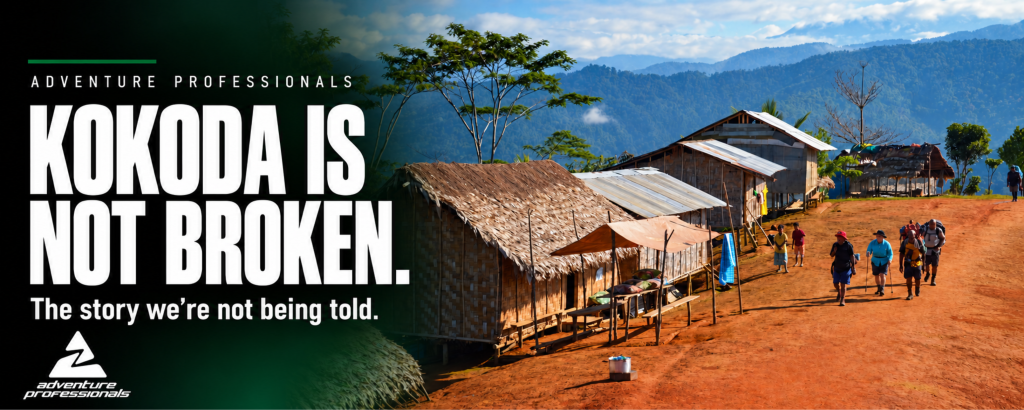
When we repeatedly describe something as broken, dysfunctional or neglected, we should ask whether we’re contributing to a solution or simply reinforcing a negative narrative.
Kokoda faces challenges.
Of course it does.
But there are also dedicated people doing valuable work.
Papua New Guinean communities building better futures.
Guides and carriers supporting their families.
Government agencies, NGOs and businesses delivering development projects.
Trekking operators creating life-changing experiences.
And young Australians discovering the history of Kokoda for the first time.
Those stories deserve attention too.
We should not confuse being the loudest critic with being the most constructive contributor.
The Future of Kokoda
So, does the future of Kokoda hang in the balance?
Like any significant historical, cultural and environmental destination, Kokoda requires ongoing investment, responsible management and a shared commitment to improvement.
But I reject the suggestion that the only way to advocate for Kokoda is to portray it as a failure.
The way forward requires cooperation.
It requires listening to the people who live along the Track.
It requires genuine engagement with local leaders, landowners, guides and carriers.
It requires transparent management, thoughtful investment and a willingness to recognise both successes and shortcomings.
It requires protecting military heritage while respecting the sovereignty and aspirations of Papua New Guinea.
And it requires acknowledging that the wellbeing of the communities living along the Track is inseparable from its long-term future.
You cannot genuinely honour the people who helped save Australian lives in 1942 while overlooking the lives of the people who call those same mountains home today.
That, to me, is where the future of Kokoda begins.
Not with competing agendas.
Not with personal grievances.
But with respect, evidence, cooperation and a shared commitment to doing better.
I’ll finish with Tim Bryson’s invitation:
“Go and visit Kokoda.”
I couldn’t agree more.
Go and experience the history.
Go and challenge yourself.
Go and meet the extraordinary people of Papua New Guinea.
Go and discover what this remarkable place has to teach you.
And when you return home, share the story.
Not just the story of the battles fought there in 1942.
But the story of the people who live there today.
Because both deserve to be remembered.
Both deserve to be respected.
And both deserve a future.

Glenn Azar
Founder and Director, Adventure Professionals
100 Kokoda Track Crossings
More than 20 years working alongside Papua New Guinean communities